What is The Physics of the Hydraulic Water Hammer?
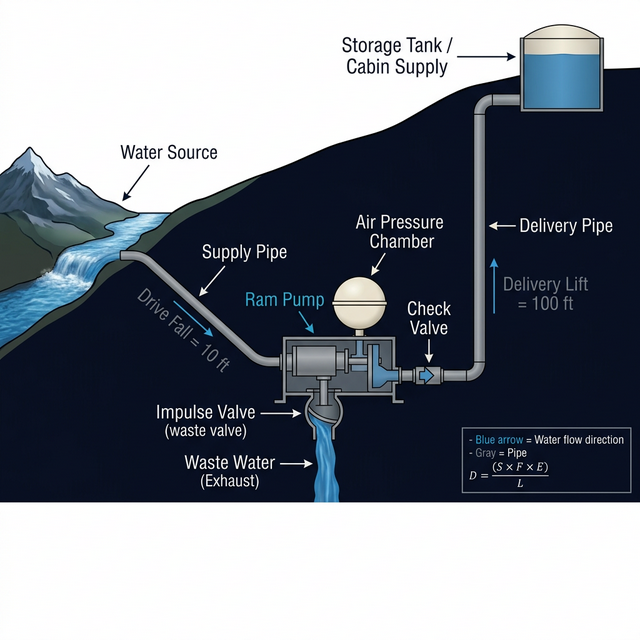
A Hydraulic Ram Pump is a miraculous piece of 18th-century engineering that pumps water uphill 24/7 using absolutely zero electricity or gasoline. It utilizes the kinetic momentum of falling water (Drive Head) to slam a heavy valve shut. This sudden stop creates a massive pressure spike (Water Hammer), forcing a tiny fraction of the water through a check valve and up a massive hill (Delivery Lift).
Mathematical Foundation
Ram Pump Delivery Yield
= A dimensionless decimal (e.g., 0.60 for 60%). Commercial cast-iron pumps achieve roughly 60-70% efficiency. DIY PVC pumps typically achieve 40%.
Waste Water Exhaust
= The massive volume of kinetic water required to slam the impulse valve shut, creating the 'water hammer' shockwave that actually pumps the delivery water up the hill.
Laws & Principles
- The 1-to-7 Lift Ratio Rule: A standard ram pump can comfortably lift water 7 feet vertically for every 1 foot of vertical 'Drive Fall' you provide it. Therefore, to push water 70 feet up a hill, your supply creek must physically drop at least 10 feet into the pump.
- Waste Water is Not Wasted: Ram pumps are loud and expel massive amounts of 'waste' water. This is not a defect; it is the physical engine. The waste water is simply the heavy mass of fluid that was falling downhill to build up the kinetic energy required to pump the tiny fraction of delivery water. It simply continues flowing down the creek.
- The Air Pressure Dome: The large metal or PVC dome on top of a ram pump is filled with compressed air. The violent water hammer pushes a splash of water into this dome, compressing the air further. The air acts as a structural shock absorber, smoothly pushing the water up the delivery pipe between hammer strikes.
Step-by-Step Example Walkthrough
" A homesteader has a creek flowing at 15 Gallons Per Minute (GPM). They can pipe it downhill with a 10-foot vertical drop before hitting the pump. They need to push the water 100 feet straight up a cliff to their cabin. They are using a commercial cast-iron pump rated at 60% efficiency. "
- 1. Identify Inputs: Supply = 15 GPM, Fall = 10 ft, Lift = 100 ft, Efficiency = 0.60.
- 2. Run the Yield Equation: (15 x 10 x 0.60) / 100.
- 3. Calculate GPM: 90 / 100 = 0.90 Gallons Per Minute delivered.
- 4. Convert to GPD: 0.90 GPM x 60 minutes x 24 hours = 1,296 Gallons Per Day.
Final Result: Despite only delivering less than 1 GPM at any given second, because it runs continuously 24 hours a day without electricity, it yields an impressive 1,296 Gallons of daily usable water at the top of the 100-foot cliff.